.svg?sfvrsn=a2a08b41_2 "Masdar-City-Free-Zone-Header-Resized")
ESG Reporting for Free Zone Businesses in Abu Dhabi: A Practical Guide

Why ESG Reporting Has Become a Business Priority in the UAE
A lot of businesses in the UAE still think ESG reporting is something only large multinational corporations need to worry about. That is changing quickly.
New climate regulations, investor expectations, and disclosure frameworks are pushing ESG reporting much closer to mandatory operational compliance. For many businesses operating in Abu Dhabi free zones, the question is no longer whether sustainability reporting matters. The real question is what now applies to them and how quickly they need to prepare.
That confusion is understandable. Several ESG-related frameworks now exist across the UAE, and they do not all apply in the same way. Some focus on greenhouse gas reporting. Others focus on investor disclosures, governance transparency, or listed-company sustainability obligations.
For free zone businesses, especially SMEs, the challenge is figuring out which rules actually affect their operations before deadlines tighten further.
The UAE Federal Climate Law entered into force on 30 May 2025, with many businesses now preparing for 2026 compliance expectations connected to emissions tracking and climate-related reporting obligations.
This is where operating within sustainability-focused ecosystems like Masdar City Free Zone can create practical advantages. Businesses already working in environments built around energy efficiency, sustainability infrastructure, and environmental accountability are often starting from a much stronger operational position.
What ESG Reporting Actually Means for Free Zone Businesses
ESG stands for Environmental, Social, and Governance reporting.
In practical terms, it means tracking and disclosing how a business operates beyond its financial performance.
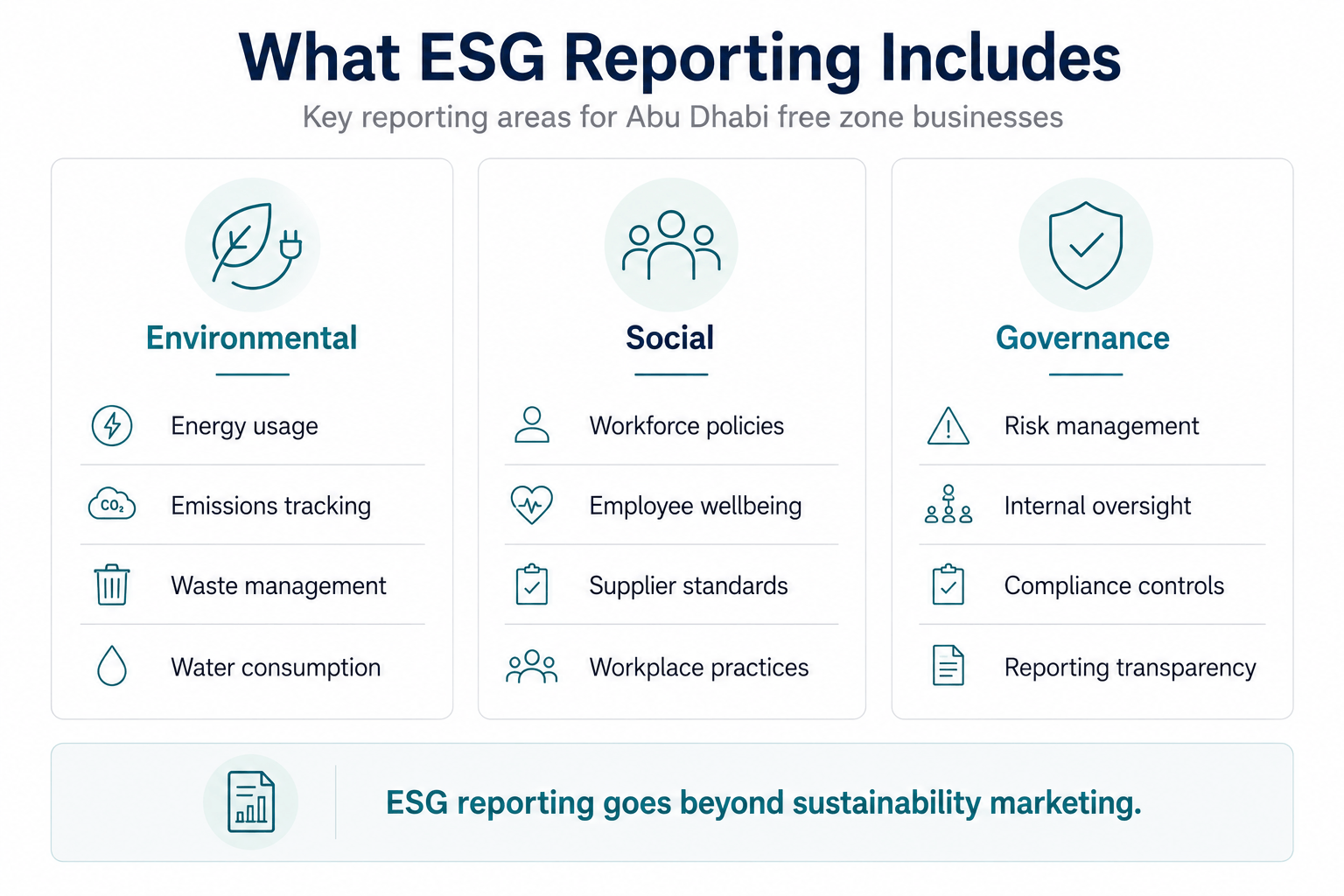
For free zone businesses in Abu Dhabi, that can include areas such as:
Energy usage
Greenhouse gas emissions
Waste management
Water consumption
Workforce policies
Governance structures
Supplier sustainability standards
Risk management practices
The environmental side usually receives the most attention because of growing climate regulations and emissions reporting requirements. But ESG reporting goes beyond carbon tracking alone.
For example:
A logistics company may need to monitor fuel consumption and transport emissions.
A manufacturing business may need to track waste and electricity usage.
A technology company may need governance policies around data, procurement, and sustainability oversight.
One important point businesses often misunderstand is this: ESG reporting is not the same thing as sustainability marketing.
Publishing a few environmentally friendly claims on a website is very different from maintaining structured sustainability data, emissions records, governance processes, and disclosure documentation.
That difference matters more now because UAE regulations are increasingly moving ESG into measurable compliance territory.
Which ESG Rules Apply to Abu Dhabi Free Zone Companies?
Several ESG-related frameworks now operate across the UAE, but they apply differently depending on the type of business involved.
The reporting obligations for a listed financial institution are not the same as those for a small free zone SME. Requirements can vary based on:
Company size
Revenue thresholds
Emissions profile
Regulatory jurisdiction
Industry activity
Public listing status
Understanding those differences early helps businesses avoid unnecessary reporting work while still preparing properly for compliance.
UAE Federal Climate Law
The UAE Federal Climate Law is one of the most important developments affecting businesses operating in the country.
The law strengthens greenhouse gas monitoring, emissions management, and climate accountability obligations across sectors. Businesses operating in the UAE, including free zone companies, are increasingly expected to track and manage emissions data where their activities generate greenhouse gas emissions.
Practical reporting obligations may vary depending on:
Business activity
Sector exposure
Emissions profile
Future implementing guidance
For many businesses, this marks the shift from voluntary sustainability initiatives toward structured environmental compliance expectations.
ADGM ESG Disclosures Framework
The ADGM ESG framework focuses more heavily on sustainability disclosures, governance transparency, and sustainable finance standards.
This framework is especially relevant for:
Regulated financial entities
Investment-related businesses
Companies operating within ADGM structures
Organizations with investor disclosure obligations
ADGM disclosure obligations are not automatically identical to the UAE Federal Climate Law. The frameworks overlap in some areas but serve different regulatory purposes.
Under the ADGM ESG framework, mandatory disclosure obligations apply to:
Entities with annual turnover above US$68 million in a financial year or
FSRA-licensed fund and asset management companies with assets under management (AUM) exceeding US$6 billion at any time during the financial year.
ADX Sustainability Reporting Requirements
Companies listed on the Abu Dhabi Securities Exchange face additional sustainability disclosure expectations linked to investor transparency and public reporting obligations.
These requirements generally go beyond the baseline reporting expectations most SMEs face.
Listed entities may need:
Formal sustainability reporting structures
Governance oversight mechanisms
Climate risk disclosures
Framework-aligned ESG reporting
Investor-facing sustainability documentation
This distinction is important because many businesses assume all ESG obligations are identical across the UAE. In reality, reporting requirements become more extensive depending on the company’s size, public exposure, and regulatory environment.
Mandatory GHG Reporting vs Voluntary ESG Reporting
Greenhouse gas reporting and broader ESG reporting are connected, but they are not the same thing.
GHG reporting focuses specifically on measuring and reporting emissions data.
ESG reporting is broader and may include:
Governance policies
Workforce practices
Risk management
Supply chain sustainability
Environmental performance
Corporate accountability
For many UAE businesses, greenhouse gas reporting requirements are becoming the starting point for wider ESG reporting obligations.
To simplify the terminology:
Scope 1 emissions are direct emissions generated by the company itself, such as fuel used in company-owned vehicles.
Scope 2 emissions come from purchased electricity or energy consumption.
Scope 3 emissions involve indirect emissions linked to suppliers, logistics, procurement, or wider operational activities.
Scope 3 reporting is often more relevant for larger organizations, listed entities, or businesses following advanced ESG frameworks rather than smaller SMEs beginning their sustainability reporting journey.
Scope 2 reporting is especially relevant for office-based free zone businesses because electricity usage often forms a significant part of their environmental footprint.
Businesses operating in energy-efficient environments may find Scope 2 tracking easier because infrastructure data is often more structured and accessible.
As ESG reporting for Abu Dhabi free zone businesses becomes more important, many companies are starting with greenhouse gas tracking before expanding into broader sustainability reporting frameworks.
Which ESG Frameworks Should UAE Businesses Use?
There is no single ESG reporting framework used by every UAE company.
Instead, businesses typically use internationally recognized frameworks based on:
Company size
Investor expectations
Industry requirements
Reporting complexity
Regulatory exposure
GRI Standards
The GRI Standards are among the most widely used sustainability reporting frameworks globally.
GRI focuses on broad sustainability transparency and stakeholder reporting. It is often used by companies preparing formal sustainability reports covering environmental, operational, and governance performance.
For many SMEs, GRI provides a useful structure for organising sustainability disclosures in a consistent way.
ISSB Standards (IFRS S1 and S2)
The ISSB standards focus more heavily on investor-focused sustainability and climate disclosures.
These standards are becoming increasingly important for businesses seeking international investment alignment or stronger climate-related reporting structures.
ISSB reporting is generally more financially focused than broader ESG narrative reporting.
TCFD Framework
The TCFD framework focuses specifically on climate-related financial risk disclosures.
This framework helps businesses explain:
Climate-related operational risks
Financial exposure
Governance structures
Climate resilience planning
It is particularly relevant for larger organizations and businesses with investor-facing reporting obligations.
SASB Standards
SASB standards focus on industry-specific sustainability disclosure guidance.
Instead of applying the same metrics to every company, SASB frameworks focus on the sustainability risks most relevant to particular industries.
For example:
Energy companies face different sustainability reporting expectations than software firms.
Logistics businesses may focus more heavily on fuel emissions and transport efficiency.
Property-related businesses may prioritize energy usage and operational efficiency.
In practice, many UAE businesses combine multiple frameworks rather than relying on a single reporting model.
ESG Compliance Checklist for Abu Dhabi Free Zone Businesses
Many companies delay ESG preparation because they assume reporting systems need to be complex from day one. In reality, most businesses benefit from starting with practical operational tracking first.
For SMEs and Smaller Free Zone Companies
Start with the fundamentals:
Identify whether emissions reporting obligations apply to your operations
Track electricity and energy usage consistently
Begin measuring basic greenhouse gas emissions
Assign internal ESG responsibility ownership
Create simple sustainability documentation processes
Review supplier sustainability exposure
Establish internal reporting records
Monitor operational resource consumption trends
Smaller businesses do not always need enterprise-level ESG reporting systems immediately. What matters first is building accurate and consistent operational tracking.
For Larger Businesses or Higher-Emission Entities
Larger organizations often require more formal ESG governance structures.
That may include:
Formal greenhouse gas inventory creation
ESG governance committee oversight
Third-party verification processes
Climate risk assessment procedures
Scope 3 supply chain mapping
Framework-aligned sustainability disclosures
Annual ESG reporting cycles
Internal audit and compliance reviews
Businesses with more complex operational footprints usually need stronger reporting controls because disclosure expectations become significantly higher as regulatory exposure increases.
Common ESG Reporting Mistakes Businesses Make
One of the biggest ESG mistakes businesses make is treating sustainability reporting as a branding exercise instead of an operational process.
That usually creates problems later when reporting requirements become more formal.
Other common mistakes include:
Waiting until reporting deadlines approach
Ignoring Scope 2 electricity data
Collecting incomplete emissions information
Using inconsistent reporting standards
Failing to assign internal ESG responsibility
Assuming SMEs are fully exempt from climate obligations
Treating ESG reporting as a one-time exercise
A practical example is energy reporting.
Many businesses discover too late that they do not have structured historical electricity data available. That creates gaps when preparing emissions calculations or sustainability disclosures later.
The businesses that adapt fastest are usually the ones already building operational tracking habits early.
How Masdar City Can Support ESG Reporting Readiness
Operating within a sustainability-focused infrastructure environment can make ESG tracking and reporting easier for businesses over time.
That does not automatically guarantee compliance, but it can create operational advantages.
Masdar City’s infrastructure includes:
LEED-certified buildings
Energy-efficient operating environments
Sustainability-focused mobility systems
Green infrastructure planning
Sustainability-oriented operational culture
For businesses managing Scope 2 reporting, this can be especially useful because electricity usage and infrastructure efficiency often play a major role in emissions tracking.
Operating in energy-efficient infrastructure environments may make Scope 2 data collection and sustainability reporting more manageable. Businesses still need their own operational energy records and internal reporting processes, but structured sustainability-focused infrastructure can help improve reporting consistency.
Companies operating within sustainability-oriented environments may also find it easier to:
Benchmark operational performance
Access structured infrastructure data
Build sustainability reporting consistency
Align with internal ESG goals
Businesses connected to Abu Dhabi’s sustainability and innovation initiatives are increasingly operating in environments where sustainability reporting expectations are already part of long-term operational planning.
Why Businesses Should Start Preparing Before Reporting Deadlines Tighten Further
ESG reporting expectations are moving quickly across the UAE.
What feels optional today can become operationally necessary much faster than many businesses expect. Climate regulation, investor scrutiny, procurement requirements, and sustainability disclosures are all moving in the same direction.
Businesses that delay preparation often face avoidable problems:
Missing operational data
Weak reporting structures
Inconsistent sustainability records
Internal accountability gaps
Last-minute compliance pressure
Starting early gives businesses more time to build reliable reporting systems gradually rather than rushing compliance efforts under pressure.
For companies operating in Abu Dhabi free zones, understanding the legal and regulatory framework for operating in Abu Dhabi free zones is becoming increasingly important as sustainability obligations continue evolving.
Building ESG Readiness Before Compliance Pressure Increases
ESG reporting is no longer limited to large listed corporations or global financial institutions.
Businesses across Abu Dhabi free zones are increasingly expected to understand how emissions reporting, sustainability disclosures, and climate-related compliance obligations affect their operations.
For many companies, the biggest advantage comes from starting early. Businesses that begin building sustainability tracking systems now are often in a stronger position when reporting expectations become more detailed later.
Operating within sustainability-focused environments like Masdar City can also make ESG readiness more manageable by supporting better operational visibility, energy tracking, and sustainability alignment from the beginning.
If you are evaluating how sustainability-focused operating structures may support long-term compliance readiness, speak with our team to explore the best setup approach for your business.
FAQs
Is ESG reporting mandatory for free zone companies in Abu Dhabi?
Certain emissions reporting and climate-related obligations are becoming increasingly mandatory under evolving UAE regulations, including the UAE Federal Climate Law.
Free zone companies are not automatically exempt, but practical reporting requirements may vary depending on:
Business activity
Industry sector
Emissions profile
Regulatory framework
Company size
For many businesses, greenhouse gas reporting is becoming the starting point for wider ESG compliance expectations.
Which ESG framework should UAE free zone businesses use for reporting?
Many UAE businesses use internationally recognized frameworks such as:
GRI Standards
ISSB standards
TCFD framework
SASB standards
These frameworks help structure sustainability reporting and disclosures, but they are not legal substitutes for UAE regulatory obligations.
Businesses often choose frameworks based on:
Investor expectations
Industry requirements
Reporting complexity
Regulatory exposure
Some companies combine multiple frameworks depending on their reporting goals.
What is the difference between the UAE Federal Climate Law and ADGM ESG requirements?
The UAE Federal Climate Law focuses primarily on climate governance, emissions management, and environmental accountability obligations across sectors.
The ADGM ESG framework focuses more heavily on:
Sustainability disclosures
Governance transparency
Sustainable finance
Investor-facing reporting
Under the ADGM framework, mandatory ESG disclosure obligations apply to:
Entities with annual turnover above US$68 million or
FSRA-licensed fund and asset management firms with assets under management exceeding US$6 billion
The two frameworks overlap in some areas but serve different regulatory purposes.
How does operating from Masdar City help with ESG Scope 2 reporting?
Scope 2 reporting focuses on emissions linked to purchased electricity and energy consumption.
Operating within Masdar City may help businesses manage Scope 2 reporting more effectively because the infrastructure is designed around sustainability-focused operations, including:
LEED-certified buildings
Energy-efficient environments
Sustainability-oriented infrastructure systems
This may help businesses access more structured operational energy data and improve sustainability tracking consistency. Businesses still need their own internal reporting systems and electricity usage records for formal ESG reporting.