.svg?sfvrsn=a2a08b41_2 "Masdar-City-Free-Zone-Header-Resized")
UAE Blue Visa Explained: How Sustainability Entrepreneurs Qualify from Masdar City

Why the UAE Blue Visa Matters for Sustainability Entrepreneurs
For years, many sustainability founders faced the same challenge when building in the UAE: creating long-term stability without depending on employer sponsorship. That mattered even more for entrepreneurs running early-stage clean tech companies, climate startups, or environmental research ventures that did not fit traditional corporate structures.
The UAE Blue Visa changes that conversation.
Introduced as a renewable 10-year residency pathway, the visa is designed for people contributing to environmental protection, sustainability, clean energy, and climate innovation. For founders and researchers already building solutions in these sectors, it creates a clearer long-term route to live and operate in the UAE independently.
That is one reason the visa has gained so much attention since applications officially opened in April, 2026. It directly aligns with the type of work already happening inside Masdar City Free Zone, where sustainability-focused businesses, researchers, and innovation-led ventures are building in sectors such as renewable energy, AI, smart mobility, and environmental technology.
For entrepreneurs looking at Abu Dhabi as a long-term base, the Blue Visa is more than a residency category. It reflects where the UAE is investing its future.
What Is the UAE Blue Visa?
The UAE Blue Visa is a renewable 10-year residency program created for individuals who have made recognised contributions to sustainability, environmental protection, climate action, or clean energy innovation.
Unlike traditional work-based residency models, the Blue Visa is self-sponsored. That means applicants do not need an employer to sponsor their residency, and the visa requires no property investment and no minimum capital threshold. This is especially relevant for founders, researchers, consultants, and independent sustainability professionals.
This program supports the country’s broader environmental and sustainability goals by attracting people actively contributing to climate-focused industries and initiatives.
The visa also reflects a larger shift happening globally. Countries competing for innovation and research talent are increasingly creating specialized residency pathways tied to sectors they want to grow. In the UAE, sustainability has become one of those priority sectors.
That matters in Abu Dhabi, where clean energy, water innovation, smart mobility, and climate technology are receiving strong institutional support. Instead of treating sustainability as a niche industry, the UAE is building long-term economic infrastructure around it.
For founders and researchers already operating in these spaces, the Blue Visa creates residency opportunities tied directly to the value they bring.
Who Qualifies for the UAE Blue Visa in 2026?
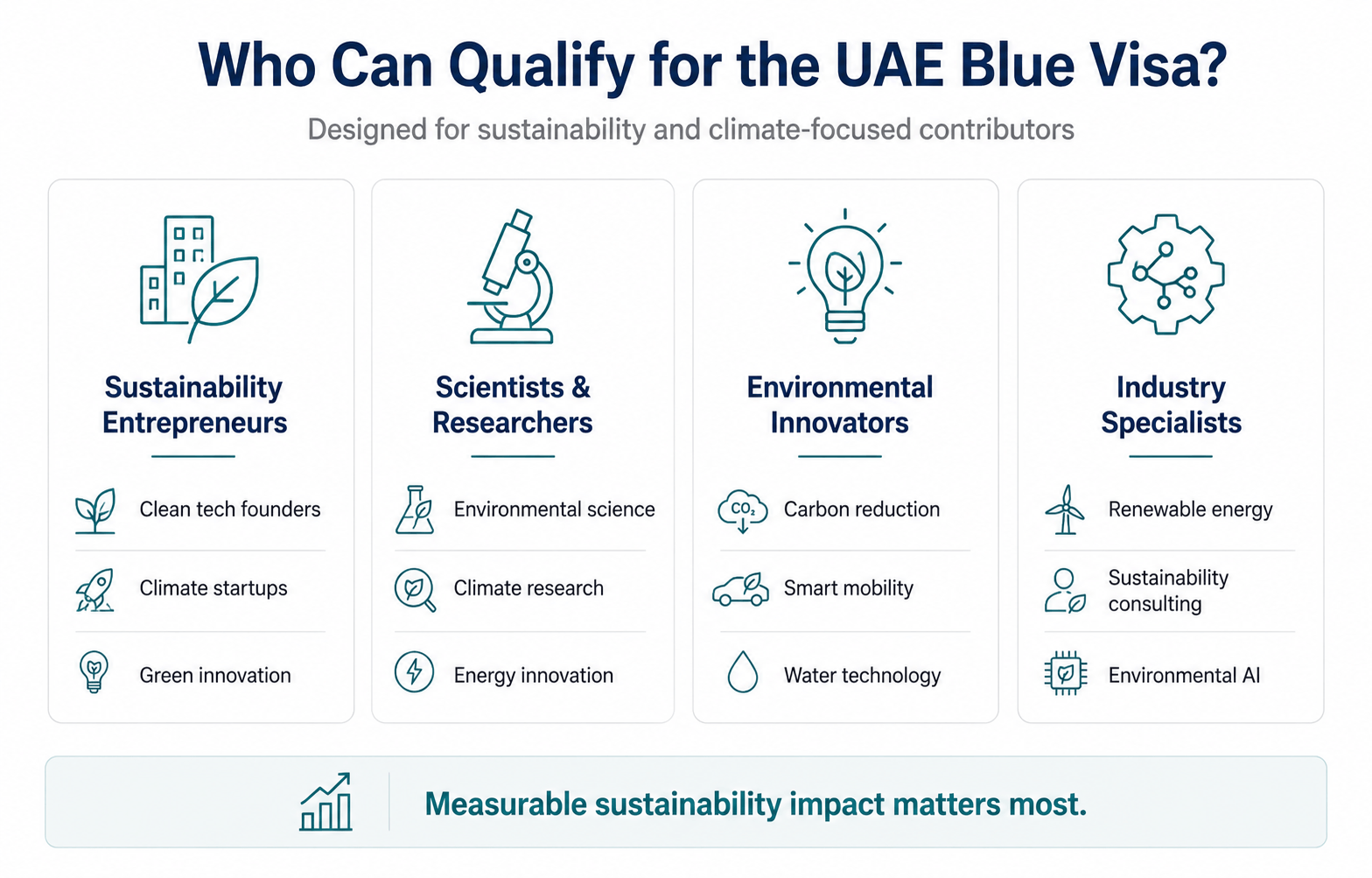
The Blue Visa is designed for people who can demonstrate meaningful contributions to sustainability, environmental protection, or climate-related innovation.
The program covers several categories, including researchers, entrepreneurs, environmental advocates, inventors, innovators, and industry specialists working in sustainability-focused sectors.
Distinguished Environmental Contributors
This category focuses on individuals whose work has created measurable environmental impact.
That could include:
Leading sustainability initiatives
Developing renewable energy projects
Supporting climate resilience programs
Contributing to environmental policy or conservation efforts
Launching technologies that reduce emissions or resource consumption
The emphasis is usually on documented contribution rather than job title alone.
For example, a founder who has developed a water-saving technology platform with verified environmental outcomes may have a stronger application than someone simply operating within a sustainability-related industry without measurable impact.
Scientists and Researchers
Researchers working in environmental science, clean energy, climate technology, or sustainability-focused innovation may also qualify.
This can include:
Academic researchers
Climate scientists
Sustainability specialists
Environmental engineers
AI researchers working on environmental applications
Clean energy technology experts
Strong supporting evidence often matters here. That may include:
Published research
Patent filings
Research partnerships
Industry collaborations
Government-supported projects
Conference participation
Recognized environmental achievements
The UAE is placing increasing focus on applied research that can support long-term sustainability goals, especially in sectors linked to energy, mobility, food security, and climate resilience.
Sustainability Entrepreneurs & Startup Founders

This is where the Blue Visa becomes especially relevant for many businesses operating in Abu Dhabi.
Entrepreneurs and investors operating in the environment, energy, climate change, and sustainability sectors may qualify if they can demonstrate meaningful environmental contribution and business activity aligned with UAE eligibility requirements.
The business itself does not need to be massive. What matters more is whether the company contributes meaningfully to sustainability objectives.
That could include businesses focused on:
Renewable energy
Carbon reduction
Smart mobility
Sustainable construction
Circular economy systems
Water technology
Agri-tech
Environmental AI solutions
Green logistics
Climate data platforms
According to recent immigration guidance, recognized SME owners or partners operating in environmental sectors and approved incubator-supported entrepreneurs may also strengthen their eligibility profile.
A founder operating a sustainability-focused company inside Masdar City may already have several elements that support a stronger application profile, including:
A recognized trade license
Sustainability reporting
Innovation partnerships
Research activity
Sector alignment with Abu Dhabi sustainability priorities
That combination creates a more credible sustainability narrative than a generic business setup alone.
Why Masdar City Is Especially Relevant for Blue Visa Applicants
The Blue Visa is closely aligned with the industries Masdar City was designed to support.
Masdar City has built its reputation around sustainability-led innovation, with dedicated focus areas including renewable energy, AI, smart mobility, life sciences, agri-tech, and environmental research. That makes it one of the few free zone ecosystems in the region where the visa’s priorities naturally overlap with the types of companies already operating there.
For founders, that alignment matters.
A sustainability entrepreneur setting up a company in a general business environment may still qualify for the Blue Visa. But a founder operating inside an ecosystem built specifically around environmental innovation often has stronger contextual support for their application.
That can include:
Operating within sustainability-focused sectors
Accessing industry partnerships
Participating in research-driven ecosystems
Producing sustainability reports
Collaborating with climate innovation initiatives
Building technologies linked to environmental outcomes
Abu Dhabi has also invested heavily in positioning itself as a global sustainability and innovation hub. Institutions connected to Masdar City, including research organizations and clean energy initiatives, reinforce that positioning further.
For founders planning long-term operations, setting up a sustainability-focused company in Abu Dhabi’s innovation ecosystem can support both business growth and residency positioning at the same time.
Can a Free Zone Founder Apply for the UAE Blue Residency Visa?
Yes. Founders operating free zone companies may qualify for the UAE Blue Visa if their work demonstrates genuine environmental or sustainability impact.
The important distinction is this: holding a free zone license alone does not automatically qualify someone for the visa.
The application focuses on contribution, innovation, and measurable value.
For sustainability entrepreneurs, that means the strength of the application often depends on evidence such as:
Environmental impact metrics
Sustainability initiatives
Research involvement
Clean technology innovation
Industry recognition
Partnerships or pilot programs
Published sustainability outcomes
Entrepreneurs operating in environment, energy, climate change, or sustainability sectors may have stronger positioning when they can clearly demonstrate commercial activity and measurable environmental contribution. Founders connected to approved incubators or recognized sustainability-focused SMEs may also benefit from additional credibility during the evaluation process.
The self-sponsored structure of the Blue Visa is particularly important for founders because it removes reliance on employer sponsorship. Entrepreneurs can build and operate independently while maintaining long-term residency eligibility tied to their own achievements and contributions.
It is also worth noting that the Blue Visa application process has both a self-application route and a nomination route. Nomination by a UAE ministry or competent authority typically results in faster processing and stronger approval credibility.
The Blue Visa supports long-term residency, but applicants should still confirm any separate work authorization or business activity requirements linked to their role or company structure.
There is also a misconception that the Blue Visa is reserved only for scientists or government-backed experts. The program is broader than that. Founders, innovators, and sustainability-driven business leaders can also fit within the eligibility framework when they can clearly demonstrate environmental value.
What Documents Are Typically Needed for a UAE Blue Visa Application?
Applicants typically need to provide documentation that proves both identity and sustainability-related contributions.
Core application documents commonly include:
A valid passport with at least six months’ validity
A recent passport-sized photograph
Professional CV
Valid UAE health insurance
Emirates ID if you’re already residing in the UAE.
Research publications
Awards certificates or industry recognition
Recommendation letters
Media coverage
Proof of current or previous employment
Educational credentials
For entrepreneurs, supporting evidence is often one of the most important parts of the application. Strong documentation helps show that the business is delivering real environmental outcomes rather than simply operating under a sustainability label.
Additional legal and eligibility updates have also been outlined in the recent Fragomen Blue Residency Visa update, including information connected to sponsorship benefits and residency structures.
How the UAE Blue Visa Application Process Works
Applications for the Blue Residency visa are submitted through the ICP online visa services platform: https://smartservices.icp.gov.ae/.
Step 1 — Submit a Nomination Request
The first step is submitting a nomination request through the ICP platform. This may be initiated directly by the applicant, or the nomination may come from a competent UAE authority. The nomination request serves as the initial approval stage before the full visa application can proceed. The fee for submitting a nomination request is AED 350.
Step 2 — Submit Your Visa Application
Once the nomination is approved by ICP, the full visa application can be submitted. At this stage, applicants will need to provide personal and identification details, including full name, contact information, category, nomination request number, and passport details. UAE residents will also need to update their visa status as part of this step. Supporting documents are uploaded and the visa service fee is completed at this point.
For Applicants Based Outside the UAE
Applicants who are outside the UAE and receive Blue Visa nomination approval are required to obtain a six-month multiple-entry visa to complete the remaining Blue Residency procedures. The fee for issuing this permit is AED 1,250.
UAE Blue Visa vs UAE Green Visa: What’s the Difference?
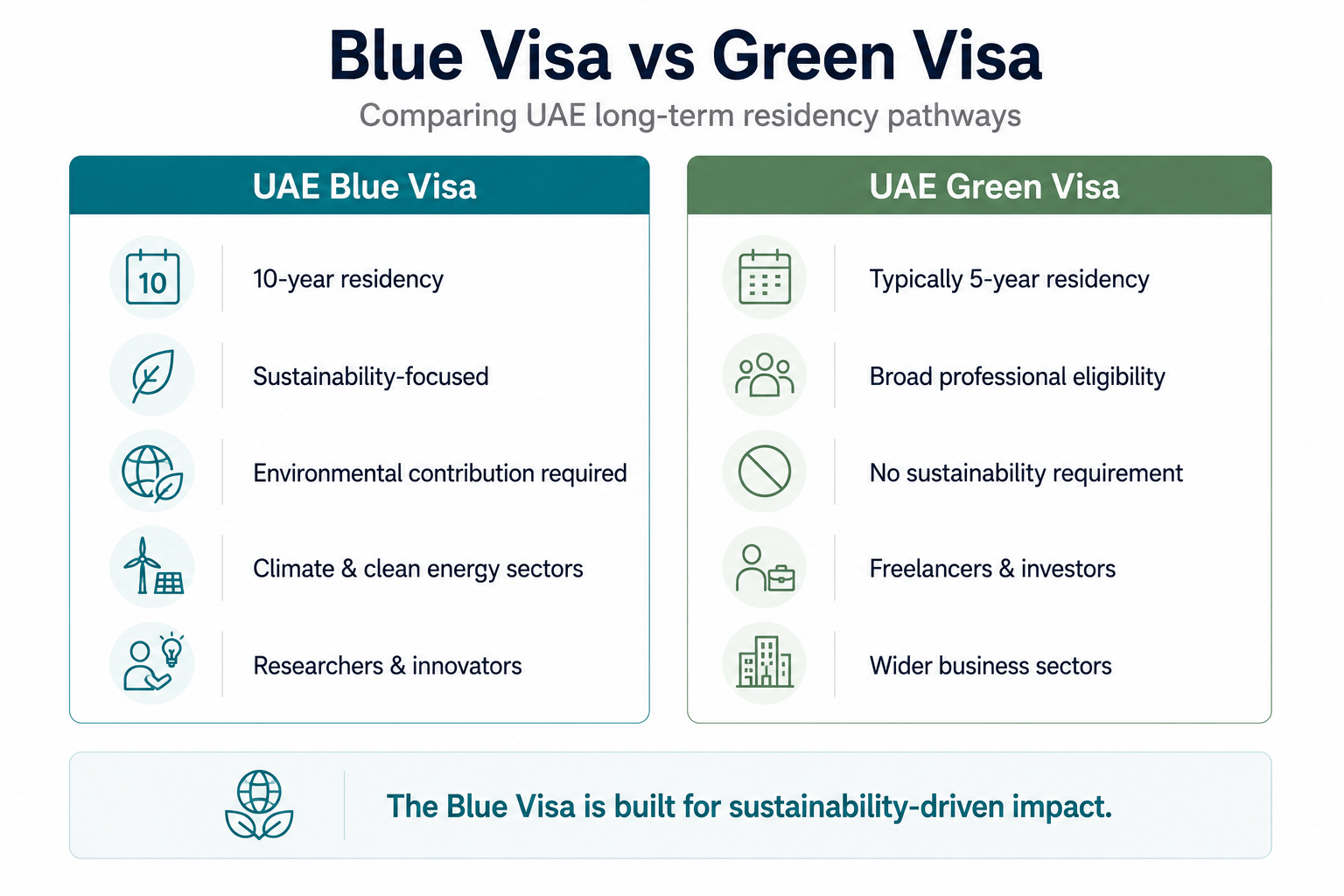
Both visas support long-term residency, but they serve different purposes.
Category | UAE Blue Visa | UAE Green Visa |
Primary Focus | Sustainability and environmental contribution | Skilled professionals, freelancers, and investors |
Residency Duration | 10 years | Typically 5 years |
Sponsorship Model | Self-sponsored | Self-sponsored |
Target Applicants | Sustainability leaders, researchers, environmental innovators | Skilled workers, entrepreneurs, freelancers |
Environmental Contribution Requirement | Yes | No |
Sector Alignment | Climate, sustainability, clean energy, environmental innovation | Broader professional and business sectors |
For sustainability entrepreneurs, the Blue Visa creates a more specialized pathway directly tied to environmental impact and climate-focused innovation.
The Green Visa and Blue Visa comparison guide from Funding Souq provides additional context around how the two residency structures differ.
What Sustainability Entrepreneurs Should Prepare Before Applying
Strong applications usually begin long before the actual visa submission.
For sustainability entrepreneurs, preparation often comes down to one thing: proving measurable impact clearly and consistently.
That includes building documentation around:
Environmental performance
Sustainability outcomes
Research activity
Product impact
Industry partnerships
Pilot projects
Regulatory alignment
Innovation milestones
Many early-stage founders underestimate the importance of structured sustainability reporting. Even simple reporting frameworks can strengthen credibility when they clearly show what the company is improving, reducing, or solving.
For example:
How much energy does the technology save?
How does the solution reduce waste?
What environmental problem is being addressed?
Are there measurable outcomes or pilot results?
Founders operating within Abu Dhabi’s sustainability and innovation initiatives may also benefit from stronger ecosystem positioning because the surrounding infrastructure already aligns closely with national sustainability priorities.
That context can help reinforce the legitimacy and relevance of the business itself.
The Long-Term Advantage of Building a Sustainability Business in Abu Dhabi
The Blue Visa is part of a much larger shift happening in Abu Dhabi.
The emirate is investing heavily in sectors tied to climate resilience, renewable energy, environmental research, advanced technology, and sustainable infrastructure. Instead of treating sustainability as a separate policy category, it is becoming integrated into long-term economic planning.
For founders, that creates advantages beyond residency.
It creates access to:
Research-driven ecosystems
Climate-focused partnerships
Sustainability investment activity
Innovation infrastructure
International market access
Government-backed sector growth
That matters for companies building in sectors expected to grow over the next decade rather than just the next funding cycle.
For sustainability entrepreneurs looking for a long-term regional base, Abu Dhabi increasingly offers both operational opportunity and strategic alignment.
Building a Stronger Long-Term Foundation in the UAE
The UAE Blue Visa gives sustainability entrepreneurs, researchers, and environmental innovators a residency pathway directly connected to the work they are already doing.
For founders building solutions around clean energy, climate technology, smart mobility, environmental AI, or sustainable infrastructure, the visa reflects a broader shift in how the UAE is supporting long-term innovation.
Masdar City sits close to the centre of that shift because its ecosystem already aligns with many of the sectors the Blue Visa is designed to support.
If you are planning to establish a sustainability-focused business presence in Abu Dhabi, speak with our team to explore the setup structure that best fits your goals.
FAQs
Who qualifies for the UAE Blue Visa in 2026?
The UAE Blue Visa is designed for people who have made recognized contributions to sustainability, environmental protection, clean energy, climate innovation, or related fields. Eligible applicants may include environmental researchers, clean tech founders, renewable energy specialists, sustainability entrepreneurs, inventors, innovators, and individuals leading projects with measurable environmental impact.
Can a free zone company founder apply for the UAE Blue Residency Visa?
Yes. A founder of a UAE free zone company may qualify for the Blue Visa if the business demonstrates genuine sustainability or environmental value. Entrepreneurs operating in environment, energy, climate change, or sustainability sectors may have stronger eligibility positioning, especially when supported by sustainability reporting, innovation projects, measurable environmental impact, or recognised incubator involvement.
What documents are needed to apply for the UAE Blue Visa?
A valid passport with at least six months’ validity
A recent passport-sized photograph
Professional CV
Published research or papers
Award certificates
Endorsement letters
Media coverage
Proof of current or previous employment
Educational credentials
Applicants commonly need:
What is the difference between the UAE Blue Visa and the Green Visa?
The UAE Blue Visa focuses specifically on sustainability, environmental contribution, and climate-related innovation, while the UAE Green Visa is aimed more broadly at skilled professionals, freelancers, investors, and entrepreneurs.
The Blue Visa offers a renewable 10-year residency structure tied to environmental impact, whereas the Green Visa generally provides shorter-term residency for wider professional categories.