.svg?sfvrsn=a2a08b41_2 "Masdar-City-Free-Zone-Header-Resized")
How to Launch a Biotech or MedTech Startup in Abu Dhabi: Masdar City Life Sciences Cluster Guide

Why Abu Dhabi Is Becoming a Global Health Innovation Hub
Healthcare startups used to look almost exclusively toward places like Silicon Valley, Boston, London, or Singapore when choosing where to build. That is changing quickly.
Abu Dhabi is positioning itself as one of the world’s most ambitious healthcare innovation ecosystems, and the emirate is making that goal very public. In May 2026, Abu Dhabi’s Department of Health announced its vision to open the emirate as a global “living lab” for healthcare innovation, inviting researchers, biotech companies, MedTech founders, and digital health businesses to help shape the future of medicine.
According to the Abu Dhabi DOH Living Lab announcement, the strategy focuses heavily on accelerating precision medicine, AI-powered healthcare, genomics, digital health, and next-generation clinical innovation.
Healthcare innovation is no longer growing only through private-sector momentum. Governments are actively building ecosystems around it. Abu Dhabi is doing that by combining regulation, infrastructure, research partnerships, and investment support into one coordinated strategy.
Programs such as Hub71+ Life Sciences are helping attract global startups, while institutions like the Department of Health Abu Dhabi continue expanding the emirate’s healthcare innovation framework.
For biotech and MedTech founders looking at the Middle East, Abu Dhabi is increasingly becoming more than a market opportunity. It is becoming an operational base for long-term growth.
This is where Masdar City Free Zone enters the conversation in a significant way.
What Is Masdar City’s Life Sciences Cluster?
Masdar City’s Life Sciences cluster was launched in 2020 to support healthcare innovation companies operating across biotechnology, genomics, pharmaceuticals, medical technology, and digital health.
The cluster is designed specifically for life sciences businesses rather than functioning as a general-purpose commercial free zone. That distinction matters because healthcare and biotech companies usually need more specialized infrastructure, regulatory coordination, and research support than a standard startup environment can provide.
The cluster currently spans approximately 18,000 square meters, with expansion plans targeting up to 70,000 square meters as Abu Dhabi continues investing in healthcare innovation capacity.
According to Masdar City Life Sciences cluster initiatives, the ecosystem focuses on areas such as:
Biomedicine
Pharmaceutical innovation
Genomics
Digital health
Medical technology
Healthcare research and development
For founders, the value is not just office space. The ecosystem is designed around operational alignment with healthcare innovation itself.
That includes:
Government collaboration
Research infrastructure
Sustainability-focused facilities
Access to healthcare partnerships
International connectivity
Regulatory ecosystem support
A biotech startup working with genomics data has very different operational needs than a traditional consultancy or e-commerce business. Masdar City’s Life Sciences cluster is structured with those realities in mind.
What Types of Biotech and MedTech Companies Can Set Up in Masdar City?
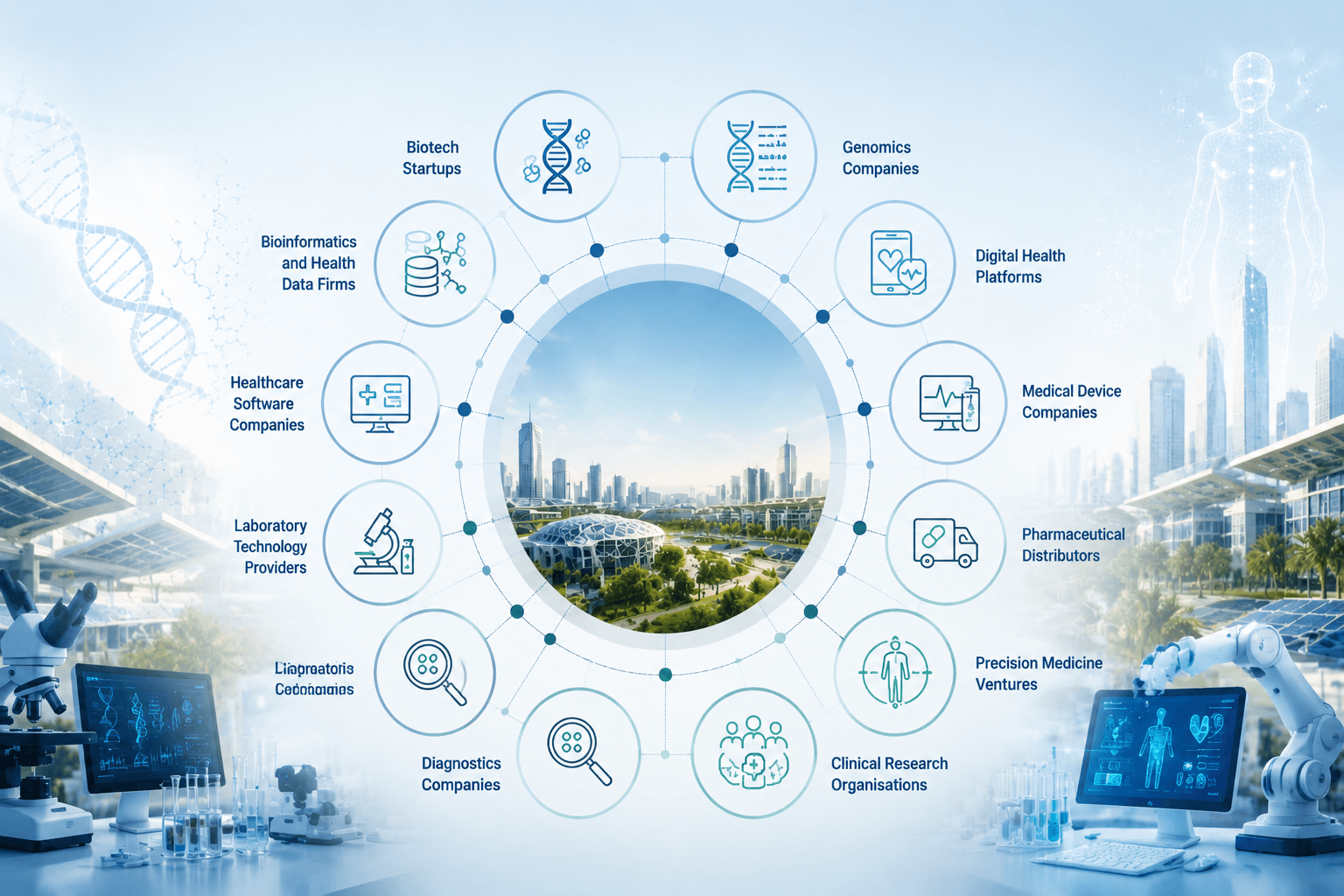
The Life Sciences cluster supports a broad range of healthcare and research-focused business models.
This includes:
Biotech startups
Genomics companies
Digital health platforms
Medical device companies
Pharmaceutical distributors
Precision medicine ventures
AI-driven healthcare businesses
Clinical research organizations
Diagnostics companies
Laboratory technology providers
Healthcare software companies
Bioinformatics and health data firms
The flexibility matters because the healthcare innovation sector has evolved rapidly over the past decade.
A modern MedTech company may combine:
AI systems
Diagnostics
Software platforms
Wearable devices
Health data analytics
Remote patient monitoring
Each of those activities can trigger different licensing or regulatory considerations.
For example:
A digital health software startup may follow a different regulatory path than a pharmaceutical distributor.
A genomics company handling sensitive health data may face stricter compliance requirements than a healthcare consulting business.
A medical device manufacturer may require product classification approvals before commercial operations begin.
This is why early regulatory planning is important for healthcare startups entering the UAE market.
What Licenses Does a Biotech or MedTech Company Need in Abu Dhabi?
Most healthcare and life sciences businesses require two separate layers of approval:
Free zone licensing
Sector-specific healthcare or regulatory approvals
The exact structure depends on the company’s activities.
Research and Development Licenses
Research-focused companies often operate under R&D-oriented licensing structures.
This may apply to:
Biotech innovation companies
Genomics startups
AI-health ventures
Diagnostics research firms
Laboratory technology developers
R&D licenses are typically relevant when businesses focus on innovation, product development, or scientific research rather than direct healthcare delivery or commercial distribution.
Medical Device and MedTech Licenses
Medical device businesses often require additional approvals depending on:
Device classification
Manufacturing activity
Import/export operations
Clinical use cases
Distribution plans
Some businesses may also need product registration or technical review processes before entering the UAE healthcare market.
For example:
Wearable healthcare devices
Diagnostic systems
Monitoring technologies
Clinical hardware
Depending on risk category and intended use, you may all face different approval pathways
Pharmaceutical Distribution and Healthcare Licenses
Pharmaceutical and healthcare-related activities usually involve stricter oversight.
This can include:
Pharmaceutical distribution
Medical storage
Clinical operations
Healthcare service delivery
Laboratory activities
The Department of Health becomes increasingly important here because healthcare-related activities often require operational compliance beyond standard commercial licensing.
One important point founders should understand early is this: healthcare regulation is intentionally stricter than standard business setup processes. Regulatory planning should happen before launch, not after incorporation.
Understanding Department of Health Approvals and Compliance
For many healthcare and life sciences businesses, the Department of Health’s involvement is part of the setup process from the beginning.
The Department of Health Abu Dhabi oversees healthcare regulation across a wide range of operational areas, including:
Healthcare licensing
Clinical standards
Medical product oversight
Laboratory regulation
Data governance
Patient safety
Healthcare compliance
Not all healthcare-related businesses require the same level of oversight. Regulatory involvement varies depending on whether the company handles clinical activity, patient data, medical products, diagnostics, or healthcare delivery.
The level of regulatory review depends heavily on the company’s activities.
For example:
A healthcare AI platform managing patient information may face data governance obligations.
A diagnostics company may require laboratory compliance approvals.
A pharmaceutical operation may require product handling and storage oversight.
Health data protection is especially important for modern healthcare startups.
Many biotech and MedTech companies now rely heavily on:
Genomics data
Clinical records
Patient monitoring information
AI-driven health analytics
Precision medicine datasets
That means founders should think about data governance and compliance infrastructure early rather than treating it as a later-stage issue.
The companies that scale most effectively in regulated healthcare environments are usually the ones that build compliance into operations from the beginning instead of trying to retrofit it later.
Government Partnerships That Strengthen the Ecosystem
One of Abu Dhabi’s biggest advantages is that healthcare innovation is being supported at an ecosystem level rather than through isolated startup initiatives.
That changes how companies scale.
DOH and ADIO Collaboration
Abu Dhabi’s healthcare innovation ecosystem is heavily supported through collaboration between the Department of Health and the Abu Dhabi Investment Office.
This matters because healthcare innovation often requires:
Long development timelines
Research support
Clinical partnerships
Regulatory coordination
International collaboration
Government-backed support helps reduce some of the friction that normally slows healthcare innovation ecosystems elsewhere.
For founders entering the region, this creates a more structured environment for long-term growth.
Emirati Genome Program and Health Data Ecosystem
One of Abu Dhabi’s most significant healthcare initiatives is the Emirati Genome Program.
Large-scale genomics initiatives create major opportunities for:
Precision medicine companies
Biotechnology research
AI-health applications
Diagnostics development
Population health analytics
The broader healthcare ecosystem and genomics initiatives create collaboration and research opportunities for qualifying healthcare and life sciences organizations operating within appropriate regulatory frameworks.
M42 and the Wider Abu Dhabi Healthcare Network
The broader healthcare ecosystem also includes organizations such as M42, which combines healthcare, AI, genomics, and technology infrastructure at scale.
For startups, ecosystems like this create opportunities for:
Clinical partnerships
Technology collaboration
Research integration
Pilot programs
Healthcare deployment opportunities
Healthcare innovation rarely scales in isolation. It usually grows through ecosystem access, institutional partnerships, and regulatory alignment. Abu Dhabi is increasingly building those pieces together intentionally.
Facility and Infrastructure Options for Life Sciences Companies

Life sciences businesses often need infrastructure that goes far beyond standard office space.
A software startup may only need desks and internet connectivity. A biotech or MedTech company may need:
Laboratory-capable and research-support infrastructure options
Controlled operational environments
Research infrastructure
Compliance-ready storage
Technical utilities
Healthcare data security systems
Masdar City’s ecosystem is designed with these operational realities in mind. Depending on the company’s stage and business model, options may include:
Flexi-desks for early-stage founders
Scalable office environments
Research-oriented operational spaces
Laboratory-support infrastructure
Technical facility expansion potential
Infrastructure flexibility is important because healthcare startups often evolve rapidly.
A company may begin as:
A research startup
A diagnostics prototype team
A digital health platform
Then later expand into:
Clinical deployment
Product distribution
International scaling
Regional healthcare operations
Location also matters operationally. Masdar City’s proximity to Zayed International Airport can support international collaboration, specialist equipment logistics, and cross-border operational coordination for healthcare businesses.
For life sciences companies operating internationally, logistics efficiency can become a meaningful operational advantage over time.
How to Launch a Biotech or MedTech Startup in Masdar City
Launching a healthcare innovation company requires more planning than a standard commercial setup. The process becomes much smoother when founders approach regulatory and operational planning early.
Step 1: Define Your Business Activity
The first step is identifying exactly what the company will do.
That affects:
Licensing categories
Regulatory approvals
Facility requirements
Healthcare compliance obligations
A healthcare software company, a genomics lab, and a pharmaceutical distributor will all follow different operational pathways.
Step 2: Choose the Right Free Zone Structure
Most companies will typically choose between:
Free zone LLC structures
Branch structures
International subsidiary setups
The right structure depends on:
Ownership goals
Expansion plans
Funding structures
Operational flexibility
Step 3: Prepare Regulatory Documentation
Healthcare businesses usually require more detailed operational documentation than standard startups.
That may include:
Product information
Research scope documentation
Compliance procedures
Data governance frameworks
Technical specifications
Operational protocols
The more regulated the activity, the more important preparation becomes.
Step 4: Secure Facility and Infrastructure Requirements
Healthcare startups should evaluate:
Lab readiness
Technical infrastructure
Security requirements
Data handling capacity
Equipment needs
Scalability requirements
Infrastructure planning should align with both current operations and expected future growth.
Step 5: Coordinate Regulatory and Operational Approvals
Depending on the business model, Department of Health approvals may run alongside free zone licensing procedures.
That is why founders benefit from understanding setup pathways early rather than treating healthcare approvals as a later-stage administrative step.
Businesses evaluating setting up a healthcare or life sciences company in Abu Dhabi’s innovation ecosystem should approach licensing and regulatory planning together rather than separately.
Why Masdar City Is Emerging as the Natural Free Zone Choice for Health Innovators
Healthcare innovation ecosystems are challenging to build because they require more than office space or startup incentives alone.
They require:
Regulatory coordination
Research infrastructure
Institutional partnerships
Technical talent
Sustainability-focused facilities
International connectivity
Masdar City is increasingly bringing those elements together in one environment.
For life sciences companies, that creates practical advantages such as:
Proximity to Abu Dhabi healthcare institutions
Government-backed innovation momentum
Sustainability-focused infrastructure
Access to healthcare partnerships
International logistics access
Research ecosystem integration
Potential support from initiatives connected to ADIO, combined with healthcare-focused infrastructure growth, also strengthens the ecosystem’s long-term attractiveness for founders evaluating regional expansion.
Businesses connected to Abu Dhabi’s healthcare and innovation initiatives are increasingly operating inside a broader strategy focused on precision medicine, genomics, AI-health, and long-term healthcare transformation.
That positioning is one reason more international biotech and MedTech founders are now looking seriously at Abu Dhabi rather than treating the region only as a secondary expansion market.
Launching the Next Generation of Health Innovation in Abu Dhabi
Abu Dhabi is no longer positioning itself simply as a healthcare market. It is building itself as a healthcare innovation ecosystem.
For biotech and MedTech founders, that changes the opportunity significantly.
Instead of operating in isolation, companies entering Abu Dhabi now have growing access to:
Government-backed healthcare initiatives
Research infrastructure
Genomics programs
AI-health ecosystems
Sustainability-focused facilities
International collaboration opportunities
Masdar City’s Life Sciences cluster sits close to the center of that strategy because it combines specialized infrastructure, healthcare ecosystem access, regulatory alignment, and long-term innovation planning in one environment.
If you’re exploring how to establish a biotech or MedTech company within Abu Dhabi’s healthcare innovation ecosystem, speak with our team to explore the most suitable setup pathway for your business.
FAQs
Can a biotech startup be set up in Masdar City Free Zone?
Yes. Biotechnology startups, genomics companies, healthcare technology businesses, diagnostics firms, AI-health ventures, and research-focused life sciences companies can establish operations within Masdar City’s Life Sciences cluster depending on their activities and regulatory requirements.
Different healthcare activities may require additional approvals alongside free zone licensing, particularly for regulated healthcare, laboratory, pharmaceutical, or medical device operations.
What licenses does a MedTech company need to operate in Abu Dhabi?
The licenses and approvals required depend on the company’s activities.
A MedTech company may require:
Free zone commercial licensing
Research and development licenses
Medical device approvals
Import/export permissions
Healthcare regulatory approvals from the Department of Health
Requirements can vary significantly depending on whether the business focuses on software, diagnostics, manufacturing, distribution, or clinical technologies.
What government support is available for life sciences companies in Abu Dhabi?
Life sciences companies in Abu Dhabi may benefit from:
Department of Health innovation initiatives
ADIO-supported ecosystem programmes
Hub71+ Life Sciences support
Healthcare research partnerships
Genomics and precision medicine initiatives
Access to broader healthcare and AI ecosystems
Regulatory collaboration opportunities
Healthcare-focused innovation infrastructure
The emirate is actively positioning itself as a long-term healthcare innovation hub with strong institutional support for biotechnology and MedTech development.
How does Masdar City's Life Sciences cluster support pharmaceutical and genomics companies?
Masdar City’s Life Sciences cluster supports pharmaceutical and genomics companies through:
Specialized life sciences infrastructure
Sustainability-focused operational environments
Access to healthcare innovation ecosystems
Proximity to research and healthcare institutions
Government-backed healthcare initiatives
Integration with Abu Dhabi’s broader genomics and precision medicine strategy
The ecosystem is designed to support healthcare innovation companies that require more specialized infrastructure and regulatory alignment than standard business environments typically provide.