.svg?sfvrsn=a2a08b41_2 "Masdar-City-Free-Zone-Header-Resized")
Autonomous Delivery and Driverless Logistics in Abu Dhabi: Business Opportunities in Masdar City’s SAVI Cluster
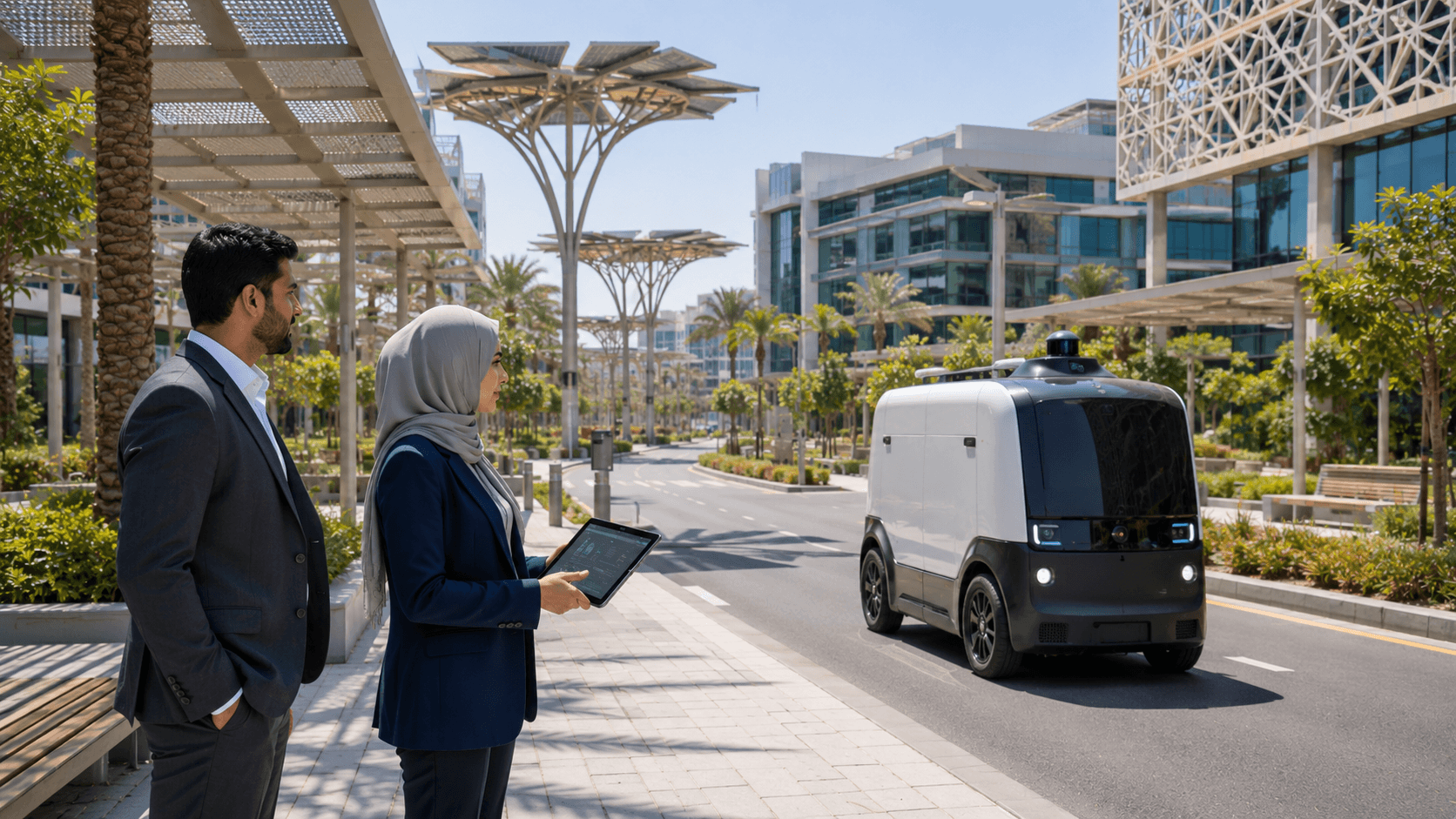
In June 2026, a UAE-headquartered autonomous delivery company called CargoX raised $250 million to scale its driverless fleet across last-mile, middle-mile, and long-haul logistics routes in Abu Dhabi and Dubai. That’s not seed-stage money chasing a future concept. That’s growth-stage capital, led by an Abu Dhabi asset manager with $15 billion under management, backing a company that’s already piloted vehicles on public roads and is preparing for commercial rollout.
If you’ve been waiting for proof that autonomous freight has moved from pilot to business, this is it.
Why Freight Is a Different Story Than Robotaxis
Most autonomous vehicle coverage in the UAE understandably gravitates toward passenger mobility. Robotaxis are visible, photogenic, and easy to put in front of a camera. Abu Dhabi has made real headway there too: fully driverless robotaxi commercial operations launched on Yas Island in late 2025, marking the first such deployment in the Middle East.
But freight is a separate category, and arguably a faster-moving one commercially. A delivery vehicle moving parcels between a warehouse and a drop-off point doesn’t need to navigate the same complexity as a vehicle carrying passengers through unpredictable city traffic with real-time route changes. Many freight routes are repeatable, point-to-point, and can run on dedicated lanes or scheduled windows, which makes the safety case and the regulatory approval process comparatively more contained.
CargoX’s plan reflects that. Its CEO, Tomaso Rodriguez, previously ran Talabat (the regional food delivery platform) and grew it significantly before steering its IPO. He’s now applying that same operational playbook to logistics: scale fast, build anchor customer relationships early, and treat autonomy as an operations upgrade rather than a moonshot. CargoX has already secured anchor relationships with companies across e-commerce, retail, and logistics, meaning there’s commercial demand lined up before the fleet even scales.
This is the part worth sitting with if you’re building or investing in this space: passenger autonomy gets the headlines, but freight autonomy might be where the money actually moves first.
What This Opens Up for Other Businesses
CargoX’s funding round isn’t really a story about one company. It’s a signal that an entire category of supporting businesses now has commercial validation behind it. A few distinct types of companies stand to benefit directly from this momentum.
Autonomous Vehicle Technology Providers
Someone has to build the sensors, the navigation stacks, the safety systems, and the vehicle hardware itself. As more logistics operators move toward autonomous fleets, the demand for specialized technology providers, companies that don’t operate the delivery service themselves but supply the underlying tech, grows alongside it.
Fleet Management Software
Running a fleet of driverless vehicles at scale is fundamentally a software and data problem: route optimization, real-time monitoring, predictive maintenance, and incident response systems. This is a software opportunity that doesn’t require building a single vehicle, which makes it accessible to a different kind of founder than the hardware-heavy AV space.
Last-Mile Delivery Operators
Not every company entering this space needs to build the autonomous technology from scratch. Operators who license or partner with existing AV platforms and focus on the operational side, routing, customer relationships, depot management, can build a business around deployment rather than invention.
Sensor and Mapping Technology Firms
Autonomous vehicles depend on extremely precise mapping and real-time sensor data to navigate safely. Companies building LiDAR systems, high-definition mapping services, or computer vision tools for vehicle navigation sit upstream of the entire autonomous logistics chain, supplying a component every AV operator needs regardless of which platform they’re running.
Regulatory and Safety Consultancies
As more companies attempt to deploy autonomous vehicles commercially, navigating the regulatory approval process becomes its own specialized skill. Consultancies that understand how to work with transport authorities, structure safety case documentation, and manage the testing-to-commercial-deployment pathway are positioned to support every other company in this list.
Where SAVI Fits Into the Picture
Masdar City’s Smart and Autonomous Vehicle Industries cluster, known as SAVI, is the part of the free zone built specifically for this category of business. SAVI was established through a partnership between the Abu Dhabi Department of Economic Development and the Abu Dhabi Investment Office in October 2023, with a mandate covering smart mobility across air, land, and sea, not just road vehicles.
That breadth matters for autonomous freight specifically. A company building ground-based delivery robots, a startup working on automated cargo handling, or a firm developing logistics drones could all sit within the same cluster, even though CargoX’s current focus is road-based freight. SAVI’s stated purpose is bringing together the value chain: attracting global companies, facilitating investment, and providing the regulatory and physical infrastructure smart mobility companies need to commercialize.
This is also where Masdar City’s track record carries some weight beyond marketing language. The free zone already operates the Personal Rapid Transit system, the world’s first on-demand autonomous electric transit network, which has moved over 3 million passengers without incident. That’s not freight, but it demonstrates the free zone’s existing operational familiarity with autonomous systems at a practical level, not just as a licensing category on paper.
How Licensing and Operational Permits Actually Work Together
One detail worth being precise about: a free zone license from Masdar City doesn’t replace the operational permits a company needs to actually run autonomous vehicles on public roads. CargoX’s own regulatory pathway illustrates how this works in practice. The company secured regulatory engagement directly with Dubai’s Roads and Transport Authority and with Abu Dhabi Mobility, the entities responsible for approving autonomous vehicle testing and deployment on actual roads.
A free zone license establishes your legal entity, handles your corporate structure, visas, and business registration, the foundation you need to operate as a company in the UAE. Operating an autonomous fleet on public roads still requires separate engagement with the relevant transport authority, since that’s a road-safety and traffic-regulation matter, not a company-formation matter. Founders entering this space should expect to manage both tracks in parallel: company setup through the free zone, and operational approval through the transport authority governing the roads they intend to use.
For companies earlier in the pipeline, before needing road approval, this is a natural starting point. It’s worth reviewing the available license and registration options to understand which activity category fits a given AV technology, software, or logistics consultancy business, since the right classification at setup stage makes the eventual conversation with transport regulators more straightforward.
Why Now Is a Reasonable Time to Move
The caution with most “the future of X is here” content is that it’s aspirational marketing dressed up as analysis. CargoX’s raise doesn’t fit that pattern. A $250 million round led by an established Abu Dhabi asset manager, with a CEO who has already taken one regional company through a major IPO, with anchor commercial relationships already signed, with regulatory engagement already secured, is a different kind of signal than a pilot program or a government white paper.
It tells investors and founders that the institutional appetite for autonomous freight in this region is real, not speculative. Abu Dhabi’s positioning here connects to a broader pattern of government entities actively shaping policy and infrastructure around autonomous and smart mobility, rather than just permitting it reactively. For companies building anywhere in the autonomous logistics value chain, technology, software, operations, or regulatory support, that combination of capital movement and institutional backing is a reasonable basis for moving now rather than waiting to see how the category develops.
Frequently Asked Questions
Is autonomous delivery legal and operational in Abu Dhabi in 2026?
Yes. Autonomous delivery vehicles have been piloted on public roads in the UAE, and companies like CargoX are preparing commercial rollout across Abu Dhabi and Dubai, having secured regulatory engagement with the relevant transport authorities.
What is the SAVI cluster at Masdar City Free Zone?
SAVI (Smart and Autonomous Vehicle Industries) is a cluster within Masdar City Free Zone established by the Abu Dhabi Department of Economic Development and the Abu Dhabi Investment Office in October 2023, focused on smart mobility across air, land, and sea.
Can an autonomous vehicle or logistics tech startup set up in a UAE free zone?
Yes. Masdar City Free Zone offers licensing for technology, software, and logistics-related business activities, including companies operating in the smart mobility and autonomous vehicle space through its SAVI cluster.
What is the difference between autonomous freight and robotaxi businesses in the UAE?
Robotaxis carry passengers through variable city traffic with real-time route changes, while autonomous freight typically runs on repeatable, point-to-point routes for moving goods rather than people, which often makes the regulatory and operational path more contained.
The momentum behind deals like CargoX’s funding round suggests autonomous logistics in the UAE is moving from pilot to commercial reality faster than many expected. If you’re exploring how to structure and license a business in this space, you can reach out to discuss your specific setup and next steps.