.svg?sfvrsn=a2a08b41_2 "Masdar-City-Free-Zone-Header-Resized")
Satellite Technology and High-Altitude Platform Businesses in Abu Dhabi Free Zones

Why Abu Dhabi Is Expanding Its Space Economy Strategy
Abu Dhabi’s space economy is no longer limited to government ambition or long-term vision statements. The sector is increasingly moving into active commercial development.
In May 2026, two announcements highlighted how quickly the ecosystem is evolving:
Mira Aerospace confirmed plans to launch an upgraded high-altitude platform system (HAPS) by the end of 2026 (WAM, 2026).
Abu Dhabi Maritime Academy announced a satellite monitoring partnership focused on maritime technology and operational intelligence (AD Ports Group, 2026).
These developments signal something important. Abu Dhabi’s space and aerospace ecosystem is becoming increasingly operational, commercially relevant, and connected to real-world infrastructure applications.
According to the above goals, it’s clear that the UAE is continuing to expand its focus on aerospace innovation, connectivity systems, geospatial intelligence, and satellite-enabled infrastructure.
That momentum builds on a broader national strategy already established through:
The UAE Space Agency
The Emirates Mars Mission
Advanced manufacturing initiatives
AI and geospatial technology investment
The UAE Space Economic Zone program launched by Masdar City Free Zone in partnership with the UAE Space Agency in 2022
The UAE’s commercial space ambitions are becoming increasingly connected to:
Logistics
Telecommunications
Environmental monitoring
Smart infrastructure
Maritime systems
Connectivity services
Earth observation technologies
For aerospace startups, satellite analytics companies, and HAPS operators, Abu Dhabi is becoming more than a symbolic innovation market. It is becoming a commercially relevant operational ecosystem.
What Are HAPS and Satellite Technology Businesses?
High-altitude platform systems, commonly known as HAPS, are typically unmanned aerial platforms designed to operate in the stratosphere at extremely high altitudes for extended periods.
They sit operationally between traditional aircraft and satellites.
Unlike satellites orbiting in space, HAPS platforms can provide:
Persistent monitoring
Communications coverage
Environmental observation
Connectivity services
Geospatial intelligence over targeted areas for long durations.
HAPS technologies are increasingly being used alongside satellite infrastructure rather than replacing it.
Together, these systems support industries such as:
Telecommunications
Maritime operations
Agriculture
Environmental monitoring
Logistics
Disaster response
Border monitoring
Infrastructure management
Satellite technology businesses themselves extend far beyond satellite manufacturing.
Many companies in the sector focus on:
Geospatial analytics
Satellite data processing
AI-powered observation systems
Earth imaging software
Aerospace engineering
Remote sensing
Navigation technologies
Aerial monitoring systems
For example:
An Earth observation company may analyse agricultural conditions using satellite imagery.
A maritime monitoring platform may use satellite data to improve vessel tracking.
A telecommunications provider may integrate HAPS systems into connectivity infrastructure.
A logistics company may use geospatial analytics to optimize supply chain visibility.
Some activities involving remote sensing, communications systems, or sensitive operational data may require additional regulatory approvals depending on the nature of the technology and its applications.
This broader ecosystem is one reason the commercial space economy is attracting growing investor and government attention globally.
What Types of Space Technology Companies Can Set Up in Abu Dhabi?
Abu Dhabi’s ecosystem supports a wide range of commercial aerospace and space-adjacent businesses.
This includes:
Satellite data analytics companies
Earth observation startups
HAPS operators
Aerospace engineering consultancies
Satellite communications providers
Space software businesses
Geospatial intelligence firms
Drone and aerial systems companies
Remote sensing technology firms
Research and advanced manufacturing businesses
Space-adjacent AI and data companies
Importantly, not every company in the sector directly builds satellites or aerospace hardware.
Many businesses operate in:
Analytics
Software
Infrastructure services
Engineering support
Operational intelligence
Telecommunications integration
That flexibility makes Abu Dhabi’s ecosystem relevant to both:
Deep-tech aerospace startups
Software-driven space economy businesses
For founders evaluating regional expansion, the ability to operate inside a broader advanced technology ecosystem can create meaningful partnership and operational advantages over time.
What Is the Space Economic Zone Program at Masdar City?
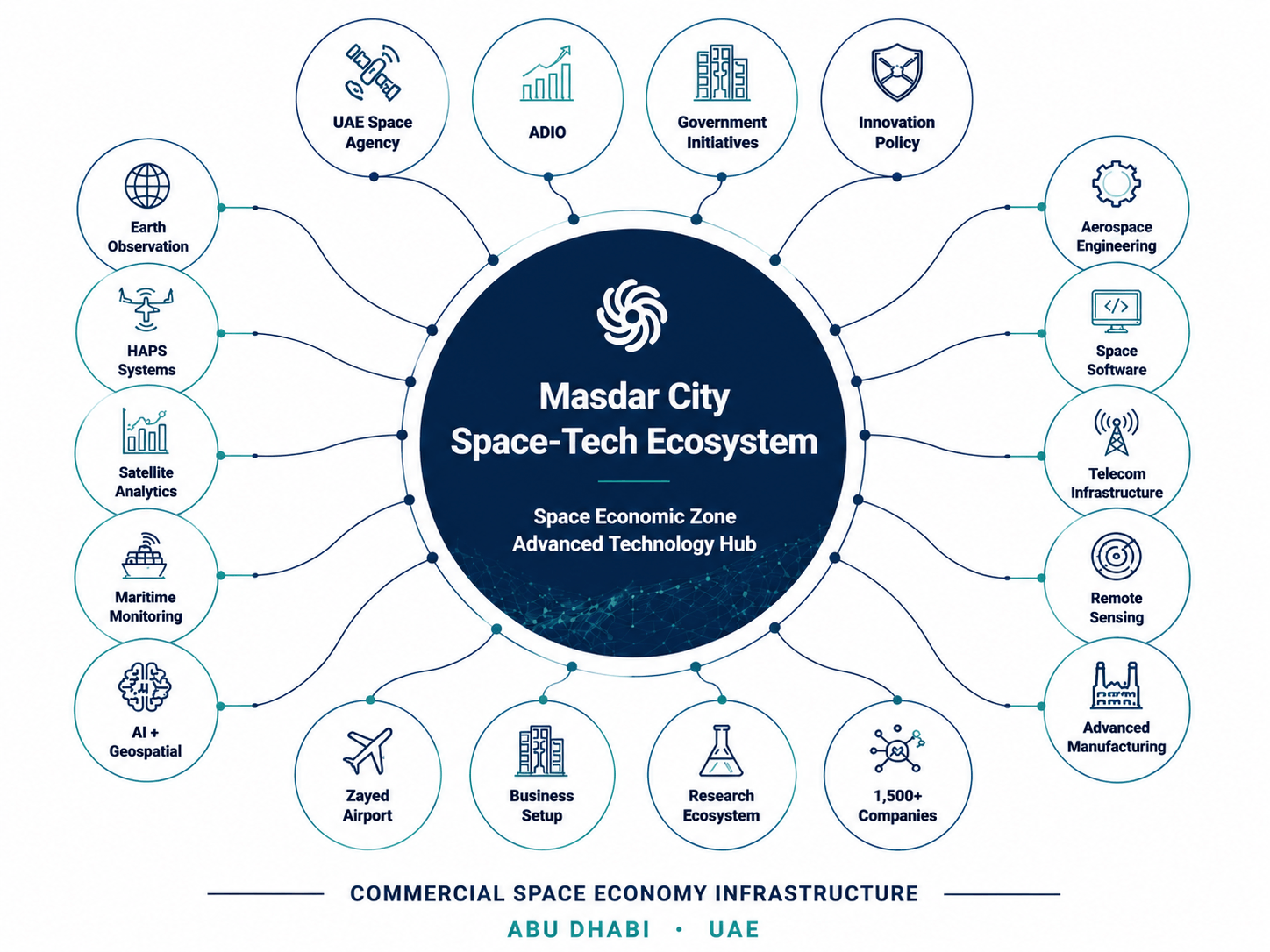
The UAE Space Economic Zone Program was launched by Masdar City in 2022 to support the growth of the country’s commercial space industry.
The initiative is connected to the UAE Space Agency and focuses on building a specialized ecosystem for space-related businesses operating in the UAE.
The aims of the initiative include:
Supporting the growth of space-related start-ups and SMEs in the UAE
Creating the UAE’s first dedicated space-tech hub and business ecosystem
Attracting global talent, investment, and innovation to the UAE space sector
Encouraging entrepreneurship and private sector participation in the space industry
Accelerating the growth of homegrown space companies
Enhancing the competitiveness of the UAE private sector
Developing national capabilities within the space industry
Advancing innovation, research, and technology development in space-related fields
Contributing to the UAE’s economic growth through the development of a space-tech economy
Providing infrastructure, mentorship, incubation, networking, and investment opportunities for space businesses
Strengthening collaboration with global research centers and international partners
Positioning the UAE as a global hub for space innovation and advanced technologies
This matters because emerging industries often grow faster when companies operate inside specialised ecosystems rather than isolated commercial environments.
The UAE Space Economic Zone helps bring together:
Government stakeholders
Advanced technology companies
Aerospace innovators
Engineering businesses
Research institutions
Investment ecosystems
Masdar City plays an important role in this structure because it already operates as a broader advanced technology and sustainability-focused ecosystem.
The Masdar City Space-Tech cluster adds another layer of operational relevance by supporting businesses connected to:
Aerospace technologies
Advanced engineering
Sustainability innovation
AI systems
Smart infrastructure
Geospatial technologies
The Space Economic Zone can support ecosystem access, industry collaboration, and regulatory coordination, but businesses still need to meet the approvals and licensing requirements linked to their specific operational activities.
For early-stage companies, ecosystem clustering can create advantages that go beyond office space alone.
What Licenses Does a Satellite or HAPS Business Need in Abu Dhabi?
The licensing pathway for satellite and aerospace-related businesses depends heavily on the company’s activities and operational model.
Some companies may operate primarily as:
Software providers
Engineering consultancies
AI analytics businesses
R&D-focused companies
Others may be involved in:
Hardware systems
Communications infrastructure
Aerospace manufacturing
Remote sensing technologies
Operational deployment platforms
Possible licensing pathways can include:
Technology consulting licenses
Software development licenses
Research and development licenses
Engineering services licenses
Manufacturing-related activities
Telecommunications-related approvals
Additional approvals may apply depending on:
Communications activity
Aerospace testing
Remote sensing operations
Cross-border infrastructure
Regulated technologies
Satellite communications systems
This is important because the space economy overlaps with multiple regulated sectors including:
Telecommunications
Aerospace
Engineering
Data systems
Advanced manufacturing
Businesses evaluating satellite technology company setup in Abu Dhabi should approach licensing strategically rather than assuming a single standard pathway applies to every business model.
How Masdar City Supports Space Technology and Aerospace Startups
Masdar City provides a combination of ecosystem positioning, advanced technology alignment, and operational accessibility that appeals strongly to aerospace and space technology businesses.
The ecosystem already supports companies operating across:
Advanced technologies
Sustainability systems
AI and data analytics
Engineering
Clean technology
Infrastructure innovation
For space-related businesses, this creates opportunities for:
Ecosystem collaboration
Partnership development
Technical networking
Operational scalability
Cross-sector innovation
Masdar City’s location also creates practical operational advantages.
The free zone is:
Approximately 5 minutes from Zayed International Airport
Positioned within Abu Dhabi’s advanced technology ecosystem
Connected to broader UAE logistics infrastructure
Within reach of Dubai’s commercial ecosystem in under an hour
Such accessibility supports businesses that rely on seamless international partnerships, coordinated engineering operations, efficient equipment movement, investor engagement, and ongoing technical collaboration.
The ecosystem’s one-stop-shop setup model can also simplify operational establishment for international founders entering the UAE market.
Businesses exploring Abu Dhabi’s advanced technology and innovation initiatives increasingly view Masdar City as a commercially practical environment for advanced engineering and aerospace-related operations.
ADIO Incentives and Government Support for Space-Tech Companies
Abu Dhabi’s broader advanced industry strategy increasingly supports emerging technology sectors including aerospace, AI, advanced manufacturing, and geospatial systems.
This creates a favorable environment for space-tech companies evaluating long-term regional operations.
Space-tech companies may be able to explore broader Abu Dhabi investment, innovation, or advanced technology support programs depending on their activity, eligibility, and strategic fit.
Potential support mechanisms connected to the ecosystem may include:
Strategic industry development initiatives
Ecosystem integration opportunities
Research collaboration potential
International investment support
Advanced industry infrastructure access
Programs connected to Abu Dhabi’s economic diversification strategy are helping attract more advanced technology businesses into sectors viewed as strategically important for long-term growth.
For international aerospace founders, one of the biggest advantages is often ecosystem positioning itself.
Operating within a growing cluster can improve:
Partnership access
Visibility within the market
Collaboration opportunities
Ecosystem integration
Long-term strategic positioning
The UAE’s continued investment into advanced industries suggests the commercial space economy will likely remain an active area of development over the coming years.
Why Early Movers May Benefit in Abu Dhabi’s Space-Tech Ecosystem
The commercial space ecosystem in Abu Dhabi is still developing compared to more mature aerospace hubs globally.
That can create advantages for companies entering early.
Businesses establishing operations now may benefit from:
Stronger ecosystem visibility
Earlier partnership opportunities
Less crowded positioning
Greater operational flexibility
Closer integration with emerging industry initiatives
This does not mean the sector is underdeveloped. The ecosystem already includes a strong foundation of government-backed initiatives, advanced technology infrastructure, international partnerships, aerospace-related commercial activity, and specialized innovation programs.
But it is still early enough that companies entering today can help shape the ecosystem rather than simply competing inside a fully saturated market.
For many founders, that positioning can become strategically valuable over time.
Why Abu Dhabi Is Becoming a Serious Commercial Space Economy Environment
The UAE’s space economy strategy is increasingly shifting from long-term ambition into practical commercial infrastructure development.
Abu Dhabi’s growing ecosystem now connects:
Aerospace innovation
Advanced engineering
Satellite technologies
Geospatial systems
AI infrastructure
Advanced manufacturing
International investment
Masdar City sits near the center of that ecosystem because it combines advanced technology positioning, operational accessibility, and specialized industry alignment within a commercially practical free zone environment.
For satellite technology companies, HAPS operators, geospatial firms, and aerospace startups, the opportunity is no longer simply about market access. It is increasingly about ecosystem participation and long-term positioning inside a growing advanced technology cluster.
Businesses exploring setting up a satellite technology or advanced engineering company in Abu Dhabi can benefit from evaluating ecosystem fit, licensing structure, and operational planning early.
If you are considering establishing a satellite technology, aerospace, or advanced engineering business in Abu Dhabi, speak with our team to explore the most suitable setup pathway for your operations.
FAQs
Can a satellite technology company set up in a UAE free zone?
Yes. Satellite technology companies, geospatial analytics firms, aerospace consultancies, Earth observation businesses, and related advanced engineering companies can establish operations within UAE free zones depending on their activities and regulatory requirements.
The exact setup pathway may vary depending on whether the business focuses on software, engineering, telecommunications, manufacturing, or operational deployment technologies.
What is the UAE Space Economic Zone at Masdar City?
The UAE Space Economic Zone is an initiative launched from Masdar City in 2022 to support the growth of the commercial space industry in the UAE.
The initiative focuses on ecosystem collaboration, aerospace industry development, regulatory coordination, research partnerships, innovation support, advanced technology integration.
The program can help support company growth and ecosystem access, but businesses must still comply with activity-specific licensing and regulatory requirements.
What licenses does a space tech or HAPS business need in Abu Dhabi?
Licensing requirements depend on the company’s activities.
Possible licensing categories may include software development, engineering services, research and development, technology consulting, manufacturing-related activities and telecommunications-related approvals.
Additional regulatory approvals may apply depending on communications systems, aerospace operations, remote sensing technologies, satellite communications infrastructure, or regulated operational activities.